The Christmas story whispers to us across centuries—not merely as historical event, but as living invitation. Yet how often do we rush past the manger scene, treating it as familiar decoration rather than revolutionary encounter? My contention is that the beauty of Christ’s birth holds a beauty we can only hope to comprehend.
Beauty as Gateway
The Pontifical Council for Culture, in its document The Via Pulchritudinis: Pathway for Evangelization (2006), wrote, “The via pulchritudinis [‘way of beauty’] can open the pathway for the search for God.”
Consider for a moment: What draws you to the Nativity story? Is it the shepherds’ wonder? The vulnerability of God as infant? The star piercing winter darkness?
The ancients understood something we’ve perhaps forgotten—that beauty isn’t merely aesthetic pleasure, but, as the aforementioned quote stated, a path to the true and living God. When we encounter genuine beauty, something shifts within us. Our defenses lower. Our hearts open. We become, however briefly, receptive to transformation.
The Nativity scene presents us with a particular kind of beauty: the beauty of paradox. Here is God, infinite and eternal, compressed into the smallness of human infancy. Here is the King of Kings, not in palace but stable. Here is power choosing powerlessness, glory veiled in obscurity.
From Observation to Transformation
But observation alone changes nothing. We can admire the birth of Christ as we might admire a painting—appreciating its composition while remaining fundamentally unchanged. The question becomes: How does encountering this beauty move from passive viewing to active transformation?
St. Augustine, as he reflected back on his life before Christ had these words to say: “Late have I loved you, O Beauty ever ancient, ever new, late have I loved you! You were within me, but I was outside, and it was there that I searched for you”. It’s clear that for one of the most profound thinkers and theologians of the Church, who saw himself as being outside the salvific Ark of the Church, beauty had a transformative power.
Think about what happens when we truly see the Nativity’s beauty:
We’re confronted with humility. If God enters the world this way—in poverty, vulnerability, among animals and working people—what does this say about our pursuit of status and security? The beauty of divine humility challenges our assumptions about power and worth.
We’re invited into wonder. The shepherds didn’t analyze the angels’ message; they marveled and responded. Wonder bypasses our intellectual defenses and speaks to something deeper. When did you last allow yourself genuine wonder at this story, rather than familiarity?
We encounter love made visible. The Incarnation isn’t abstract theology—it’s God saying “I will enter your world, your limitations, your suffering.” This is beauty as self-giving, as descent rather than ascent.
The Revolutionary Implications
Here’s where transformation becomes revolution: The Nativity doesn’t just offer personal spiritual comfort. It upends our understanding of how God works in the world. The Child in the manger was then, is now, and will be forever the King of All (Mt. 2:2; Rev. 11:15; Lk. 1:33).
If God enters through the margins rather than the center, through weakness rather than strength, through the overlooked rather than the celebrated—what does this mean for how we live? For whom we notice? For what we value?
The beauty of the Incarnation revolutionizes when we let it reshape our seeing:
- We begin noticing the overlooked. Like God choosing shepherds as first witnesses, we start recognizing divine presence in unexpected places and people.
- We redefine strength. Power that serves, that descends, that makes itself vulnerable for another’s sake—this becomes our new north star.
- We embrace our own smallness. If God is comfortable with such apparent insignificance, perhaps our obscurity, our limitations, our ordinary lives are precisely where transformation happens.
Living the Beauty
Transformation isn’t merely emotional experience—it must become embodied reality. How do we let the Nativity’s beauty revolutionize our actual lives?
Perhaps it begins with simple practices: Sitting with the story rather than rushing past it. Asking what disturbs us about it—because what disturbs often reveals what needs transforming. Noticing where we resist its implications.
The beauty of the Incarnation invites us to a revolution that starts internally but can’t remain there. It spills outward into how we treat the vulnerable, how we use power, how we define success, how we spend our time and resources.
The Ongoing Encounter
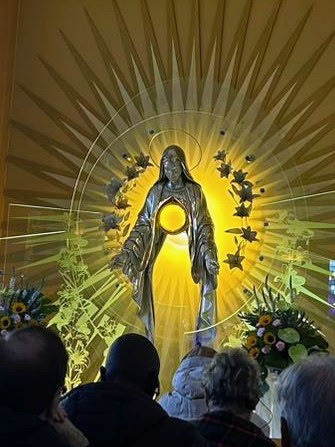
The deepest beauty of Christ’s Nativity is this: It isn’t simply an event we commemorate, but a reality that continues. The God who chose to enter our humanity doesn’t abandon that choice. The same humility, the same proximity to the marginalized, the same self-giving love—these remain God’s way of being in the world.
When we seek the beauty of the Nativity, we’re not just looking backward to a stable in Bethlehem. We’re learning to recognize how God still enters our world—often in ways just as unexpected, just as humble, just as easily overlooked.
The question isn’t whether encountering this beauty can transform and revolutionize us. The question is whether we’ll let it. Whether we’ll move from admiring the scene to inhabiting its reality. Whether we’ll let the beauty of divine descent become the pattern of our own lives.
What would change if you truly believed that God still works this way—choosing the small over the grand, the hidden over the obvious, the vulnerable over the powerful? What would shift if you let that beauty not just inspire you, but reshape you?
The star still shines. The invitation still stands. The beauty of Christ still waits to do its transforming work.
“The sweetest thing in all my life has been the longing – to reach the Mountain, to find the place where all the beauty came from” – Psyche in C.S. Lewis’s Till We Have Faces

 The Road To Wonder
Leave a comment